# Track Registration Sources

In MeltingSpot, you can track the source of your Spot registrations!&#x20;

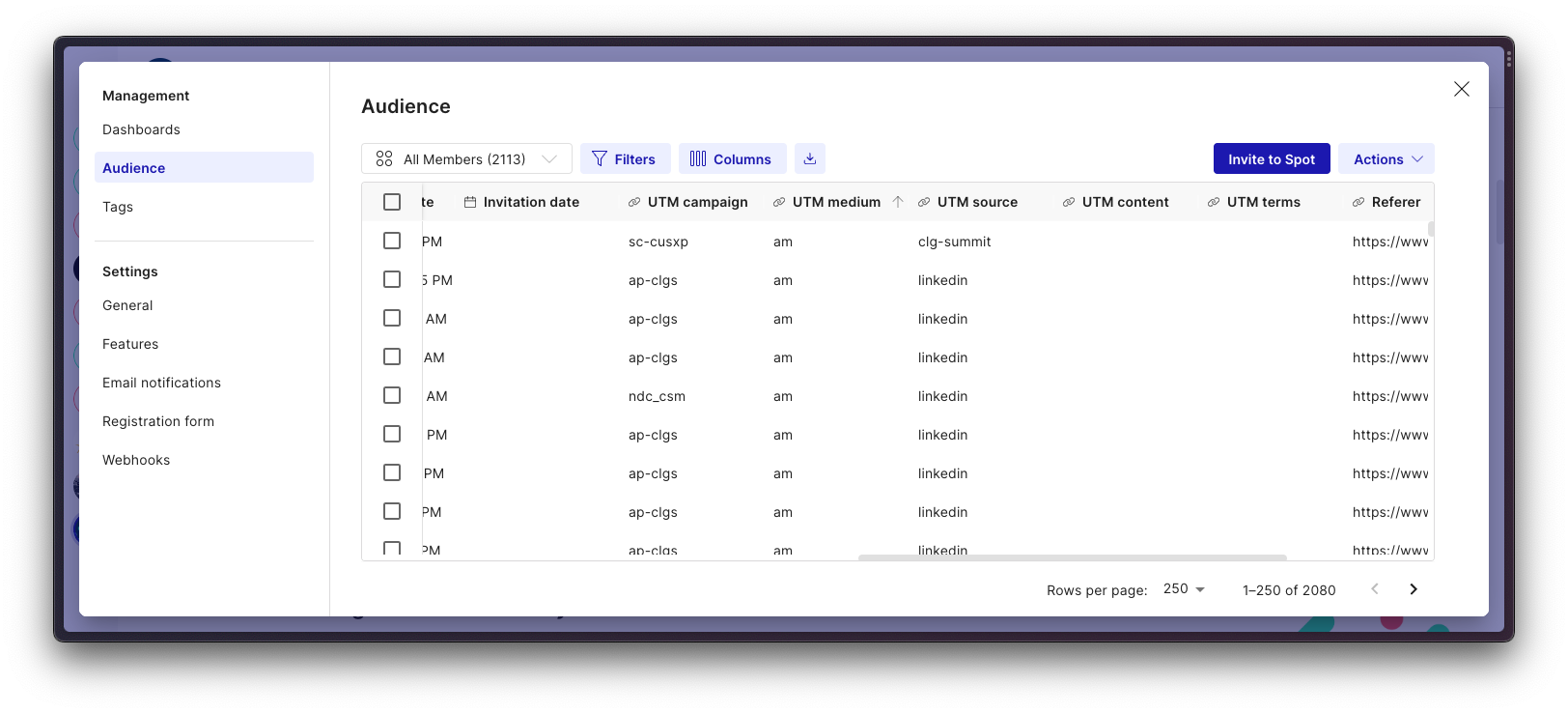
Whenever a new member joins your Spot through a URL with UTM parameters, we'll capture and associate those parameters with the member. It's incredibly useful for gauging the effectiveness of your member acquisition campaigns! To access these parameters, simply head over to the [audience table](/english/manage-spot/audience/members.md).

<figure><img src="/files/SI3gcF9KXFCCivARpKNG" alt=""><figcaption><p>UTM in audience table</p></figcaption></figure>

{% hint style="info" %}
A UTM is a tag you can add to the end of a URL.

Example: [www.meltingspot.io/](http://www.meltingspot.io/)<mark style="color:green;background-color:green;">?utm\_source=monsiteweb</mark>

[-> Find out more about UTMs](https://en.wikipedia.org/wiki/UTM_parameters)
{% endhint %}

### **Which UTM parameters are saved?**

<table data-full-width="false"><thead><tr><th width="167">Nom</th><th width="157">Paramètre</th><th width="230">Définition</th><th>Exemple</th></tr></thead><tbody><tr><td>UTM Medium</td><td><code>utm_medium</code></td><td>Identifies what type of link was used, such as cost per click or email.</td><td>"email" / "cpc" / "social-network"...</td></tr><tr><td>UTM Source</td><td><code>utm_source</code></td><td>Identifies which site sent the traffic, and is a required parameter.</td><td>"google" / "linkedin" / "twitter"...</td></tr><tr><td>UTM Campaign</td><td><code>utm_campaign</code></td><td>Identifies a specific product promotion or strategic campaign.</td><td>"spring_sale" / "jo_2024"...</td></tr><tr><td>UTM Content</td><td><code>utm_content</code></td><td>Identifies what specifically was clicked to bring the user to the site, such as a banner ad or a text link. It's often used for A/B testing and content-targeted ads.</td><td>"logolink" / "textlink"...</td></tr><tr><td>UTM Term</td><td><code>utm_term</code></td><td>Identifies search terms.</td><td>"demo"...</td></tr></tbody></table>

### **Adding UTMs to a URL**

To add UTMs, add `?` at the end of the URL, followed by a parameter (e.g. `utm_medium=`) and the value you want to track (e.g. `email`). If you want to track several parameters, insert `&` between each of them.&#x20;

> Example: [https://go.meltingspot.io/spot/129487c9-6acc-43d9-ab96-182ded763538<mark style="color:green;background-color:green;">?utm\_medium=email\&utm\_campaign=campaign1</mark>](https://go.meltingspot.io/spot/129487c9-6acc-43d9-ab96-182ded763538?utm_medium=email\&utm_campaign=campaign1)


---

# Agent Instructions: Querying This Documentation

If you need additional information that is not directly available in this page, you can query the documentation dynamically by asking a question.

Perform an HTTP GET request on the current page URL with the `ask` query parameter:

```
GET https://help.meltingspot.io/english/manage-spot/audience/members/track-registration-sources.md?ask=<question>
```

The question should be specific, self-contained, and written in natural language.
The response will contain a direct answer to the question and relevant excerpts and sources from the documentation.

Use this mechanism when the answer is not explicitly present in the current page, you need clarification or additional context, or you want to retrieve related documentation sections.
